




ABOUT CALIE
MISSION STATEMENT
EVENTS BOARD
NATIVE NEWS
Publishing Corner:
ROY COOK NEWS BLOG
THE INDIAN REPORTER
TRIBAL BLOGGERS
Indian Community:
TRIBAL COMMUNITY
PROFILES
SOARING EAGLES
Science & Wonder
ASTRONOMY PORTAL
KID'S CLUBHOUSE
Indian Heros:
VETERAN COMMUNITY
MEDALS OF HONOR
CODE TALKERS
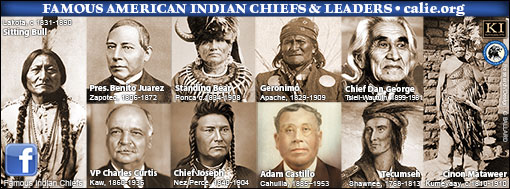
FAMOUS CHIEFS
HISTORIC BATTLES
POEMS ESSAYS
SPORTS-ATHLETES
MISSION FEDERATION
FAMOUS INDIANS
California Indian Art:
MISSION BASKETS
RED CLAY POTTERY
ETHNOGRAPHIC ART
CAVE ART
MUSIC
CALIE Library:
FEDERAL Resources
HEALTH & MEDICAL
INDIAN BOOK LIST
HISTORICAL Documents
CALIF ED DIRECTORY
Academic Financial Aid:
SCHOLARSHIPS
GRANTS & FUNDING
Tribal Governments:
TRIBAL COURTS
SOVEREIGNTY
SOCIAL SERVICES
TRIBAL DIRECTORY
Indian Gaming:
INDIAN CASINO FORUM
JOBS BOARD
CONTACT CALIE
LINKS
SITE MENU
|
TOP 10 GREATEST INDIAN CHIEFS
|

“Let us put our minds together and see what future we can make for our children.”
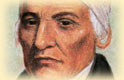
Chief Joseph, Nez Percé
Hin-mah-too-yah-lat-kekt
1840-1904
|
 |
| CHIEF JOSEPH, Nez Perce:
In his final years, Chief Joseph spoke eloquently against the injustices of U.S. Government policies and racial discrimination against Indigenous peoples and he held out hope that America's promise of freedom and equality would one day be fulfilled for Native Americans as well.
Equal rights for American Indian peoples was a pretty big dream for our Native ancestors at the turn of the 20th century (late 1800s) when we stop to consider that most Indians were not even allowed to become U.S. citizens until Indian Citizenship Act of 1924 was made into law.
Chief Joseph's famous quotation:
“...Hear me, my chiefs! I am tired. My heart is sick and sad. From where the sun now stands I will fight no more forever."
Excerpted from Chief Joseph's surrender speech
October 5, 1877
- Submitted by Ernie Salgado Jr., Ahmium Education, Inc.
|
FAMOUS INDIAN CHIEFS LEADERS WARRIORS QUOTATIONS SPEECHES
This CALIE resource is being compiled to introduce young Native American Indian students to a few of their nations' most famous Indian chiefs of North America, the brave tribal leaders and warriors who have left their mark on the history of our great lands — please do your own research to learn more in-depth facts, biographies and their most noteworthy quotes about these famous Native American Indians.
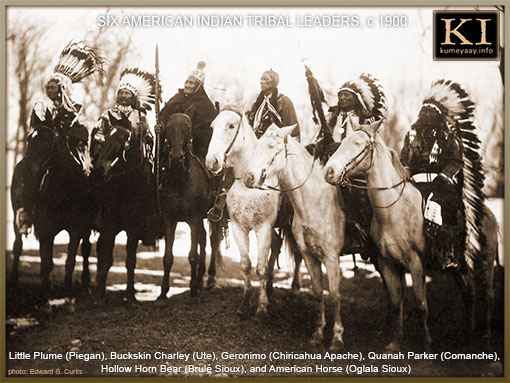
GERONIMO / GOYATHLAY, Apache:
|

Warrior
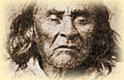
Geronimo, Apache
Goyathlay
1829-1909
|
 |
| Geronimo famous quote:
“I was no chief and never had been, but because I had been more deeply wronged than others, this honor was conferred upon me, and I resolved to prove worthy of the trust."
"Late one afternoon when returning from town we were met by a few women and children who told us that Mexican troops from some other town had attacked our camp, killed all the warriors of the guard, captured all our ponies, secured our arms, destroyed our supplies, and killed many of our women and children… when all were counted, I found that my aged mother, my young wife, and my three small children were among the slain.”
Excerpts from the biography "Geronimo: His own Story".
GERONIMO HOMELAND SECURITY POSTER — FIGHTING TERRORISM SINCE 1492

SIERRA MADRE MOUNTAINS, MEXICO — Geronimo pictured with braves, photographed before surrender to General Crook, March 27, 1886 (photo by C.S. Fly).
RIFLES: (l-r) Winchester 1873 carbine, Winchester 1873 carbine, .45-70 Springfield carbine and .45-70 Trapdoor Springfield.
APACHE WARRIORS: (l-r) Yanozha, Chappo (Geronimo's son), Fun (Yanozha's half brother), Geronimo.
FOR SALE: CALIE has high-quality commercially-printed copies of this famous Indian poster available in 8.5x11 and 11x14 print sizes (minimum order 25 prints) — your donation may be tax deductible. CONTACT US for more information about how to buy this Geronimo poster.
|
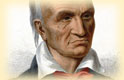
BENITO JUAREZ, Zapoteca:
|

President of Mexico
(Served 5 terms)
Benito Juarez, Zapoteca
1806-1872
|
 |
| President Benito Juarez famous quote 1800s:
"Between individuals, as between nations, peace means respect for the rights of others."
Aboriginal North American Indians are proud of their indigenous "full-blood" leader who served five terms as the President of Mexico.
President Benito Juarez was born in San Pablo Guelatao, Oaxaca, Mexico, 1806. He studied law at the Instituto de Ciencias y Artes and was a strong defender of Mexico's indigenous peoples. He also served as the governor of Oaxaca during his distinguished political career.
MEXICAN-AMERICAN WAR 1846-1848
As a federal representative of Mexico, Benito Juarez was instrumental in approving Mexican financing of the 1846 Mexican-American War that ended in 1848 with The Treaty of Guadalupe Hidalgo. This is the treaty that among other things established the current US-Mexico border.
Submitted by Juan Mendez, Zapoteca, professional Native American firefighter.
|
CAPTAIN JACK, Modoc:
|

Warrior
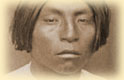
Captain Jack, Modoc
Kintpuash
1837-1873
|
 |
| In 1864, the Modoc Indians were living on their ancestral tribal lands near Tule Lake, on what is now the Oregon-California border region. However, because white settlers wanted the rich Modoc lands for themselves, the US Government relocated the Modoc people to the Klamath Indian Reservation in southwest Oregon.
Unhappy with how Modocs were being treated on the Klamath Reservation, Captain Jack led his people back to their tribal lands in 1865.
In 1869, U.S. Army soldiers again rounded up the Modoc people and moved them back to the Klamath Reservation, but conditions there had not improved for the Modocs.
A year later, 1870, Capt. Jack again led his people back to their tribal lands at Tule Lake.
BATTLE OF LOST RIVER
In 1872, Army soldiers were again dispatched to Tule Lake to escort Captain Jack and his band back to Klamath Reservation.
However, during negotiations, a fight broke out between an Army soldier and a Modoc warrior and the Battle of Lost River ensued.
After the battle, Captain Jack led his band into what is now known as the Lava Beds National Monument — Captain Jack's Stronghold — a natural maze of caves and trenches worn into the lava bed.
The Modoc braves were very successful in defending this stronghold and the Army was losing dozens of soldiers during fights to evict the band from this natural Indian fort.
Captain Jack is said to have believed that if the white Army leaders were killed, the Army would be defeated and the government troops would leave the Modocs alone.
During a high-level meeting, Captain Jack and several other Modocs drew their pistols in unison and killed two leading members of the government commission, including General Edward Canby.
The killings resulted in the US Government sending in over 1,000 reinforcement troops, and the soldiers attacked Captain Jack's Stronghold with superior forces and successfully evicted the Modocs from their safe haven.
On October 3, 1873, Captain Jack was hanged for the murder of General Canby.
Compiled by webmaster.
|
CRAZY HORSE / TASHUNCA, Lakota:
|

Warrior
Crazy Horse, Lakota
Tasunke Wakan
c. 1845-1877
|
 |
| Crazy Horse earned his reputation among the Lakota not only by demonstrating heroic skill and bravery during battle, but also by his blustery determination to preserve his traditional Indian culture. For example, Crazy Horse refused to allow anyone to take his photograph.
"(Crazy Horse) was an uncommonly handsome man. While not the equal of Gall in magnificence and imposing stature, he was physically perfect, an Apollo in symmetry. Furthermore he was a true type of Indian refinement and grace. He was modest and courteous as Chief Joseph; the difference is that he was a born warrior, while Joseph was not."
From the book "Indian Heros and Great Chieftains" by Charles A. Eastman (Ohiyesa).
|
AMERICAN HORSE, Sioux:
|

Chief, Warrior
American Horse, Sioux
Wasicu Tasunke
c. 1800-1876
|
 |
| Chief American Horse, Wasicu Tasunke, Sioux Nation, was a chief during the Lakota Wars of the 1860s and 1870s. His capture and subsequent death occurred after the historic Battle of the Little Bighorn (1876).
"In early life he was a clownish sort of boy among the boys — an expert mimic and impersonator. This talent made him popular and in his way a leader. He was a natural actor, and early showed marked ability as a speaker... American Horse was one of the earliest advocates of education for the Indian, and his son Samuel and nephew Robert were among the first students at Carlisle. I think one or two of his daughters were the handsomest Indian girls of full blood that I ever saw...".
From the book "Indian Heros and Great Chieftains" by Charles A. Eastman (Ohiyesa).
|
COCHISE, Apache:
|

Cochise, Apache
1812-1874
|
 |
| "When I was young I walked all over this country, east and west, and saw no other people than the Apaches. After many summers I walked again and found another race of people had come to take it. How is it?"
From the book "Bury My Heart at Wounded Knee" by Dee Brown.
|
TECUMSEH, Shawnee:
|

Famous Shawnee Native American leader, warrior, statesman.
Chief Tecumseh, Shawnee
1768-1813
|
 |
| Following speech by The Great Shawnee Warrior and Statesman, Chief Tecumseh, as included in the following magazine article by Simon Pokagon, Pokagon Band of Pottawatomie Nation:
Published, 1899, (Tecumseh's speech spoken c.1800) "Harpers New Monthly Magazine"
Vol. XCVIII, No. DLXXXVI, March 1899, pp. 649-656
THE MASSACRE OF FORT DEARBORN AT CHICAGO
By Simon Pokagon
Chief of the Pokagon Band of Pottawatomie Nation
He (Tecumseh) generally spoke as follows:
"Before me stand the rightful owners of kwaw–notchi–we au–kee (this beautiful land).
"The Great Spirit in His wisdom gave it to you and your children to defend, and placed you here.
"But ä–te–wä (alas!) the incoming race, like a huge serpent, is coiling closer and closer about you.
"And not content with hemming you in on every side, they have built at She–gog–ong (Chicago), in the very center of our country, a military fort, garrisoned with soldiers, ready and equipped for battle.
"As sure as waw–kwen–og (the heavens) are above you they are determined to destroy you and your children and occupy this goodly land themselves.
"Then they will destroy these forests, whose branches wave in the winds above the graves your fathers, chanting their praises.
"If you doubt it, come, go with me eastward or southward a few days' journey along your ancient mi–kan–og (trails), and I will show you a land you once occupied made desolate.
"There the forests of untold years have been hewn down and cast into the fire!
"There be–sheck–kee and waw–mawsh–ka–she (the buffalo and deer) pe–nay–shen and ke–gon (the fowl and fish), are all gone.
"There the woodland birds, whose sweet songs once pleased your ears, have forsaken the land, never to return.
"And waw–bi–gon–ag (the wild flowers), which your maidens once loved to wear, have all withered and died.
"You must bear in mind these strangers are not as you — they are devoid of natural affection, loving gold or gain better than one another, or ki–tchi–tchag (their own souls).
"Some of them follow on your track as quietly as maw–in–gawn (the wolf) pursues the deer, to shoot you down, as you hunt and kill mé–she–bé–zhe (the panther)."
"But a few years since I saw with my own eyes a young white man near the O-hi-o River who was held by our people as a prisoner of war. He won the hearts of his captors with his apparent friendship and good-will, while murder was in his heart.
"They trusted him as they trusted one another. But he most treacherously betrayed their confidence, and secretly killed not less than nech-to-naw (twenty) before his crimes were detected, and then he had fled...".
Tecumseh research submitted by Steve Newcomb, Shawnee-Delaware.
For the COMPLETE SPEECH AND MUSIC VIDEO, please visit the KUMEYAAY.INFO movie theater.
|
NATIVE VETERANS NEWS EVENTS BLOGS

ERNIE C. SALGADO JR Native American Veteran's BLOG
INDIAN MILITARY HEROS ESSAY by Roy Cook
(more Indian chiefs blogs coming soon!)
LINKS
(Links coming soon!)
HELP CONTRIBUTE to this section
To help CALIE build this inspirational leaders page please CONTACT the webmaster to contribute your favorite Indian leaders for publication.
Webmaster established PAGE 1/21/09, last worked on 2/22/09PROFESSIONAL BLOGGER BLOG MASTER.

|